
Dehydrated Vegetables Powder

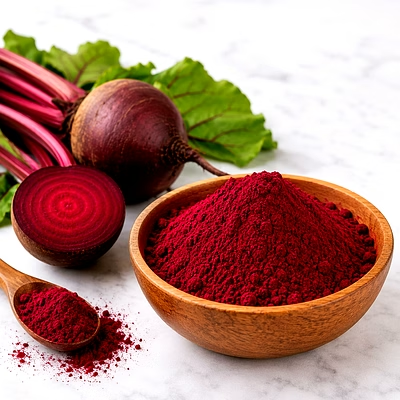
Dehydrated Beetroot Powder Deep Red 80–100 Mesh Food And Health Ingredient
dehydrated beetroot powder for food ingredient use
Dehydrated beetroot powder is a deep-red, shelf-stable ingredient used for natural coloring, nutraceutical blends, and functional food formulations. It supplies natural betalains and fiber in a fine powdered form suitable for blending into mixes, beverages, sauces, and bakery formulations. The powder's 80–100 mesh particle size supports uniform dispersion and consistent color payoff in dry and wet systems.
Technical Specifications & Grading
- mesh: 80–100 mesh
- color: deep red (betalain-rich)
- moisture: low-moisture handling for stability
- packaging: bulk lined bags or cartons
Bulk Supply & Logistics Terms
- MOQ: Commercial bulk volumes available upon request
- Lead Time: Scheduled based on volume and packaging
- Supply Capacity: Scalable monthly supply for recurring procurement
- Packaging: 25 kg lined bags, cartons or bulk sacks
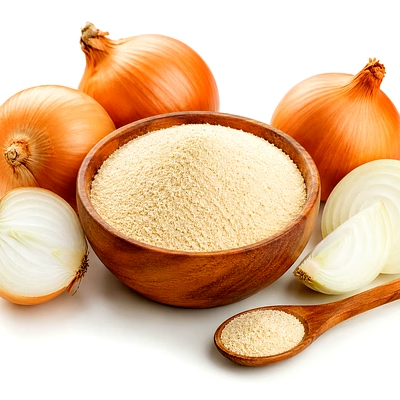
Dehydrated Onion Powder Off-White 80–100 Mesh Food Ingredient For Seasoning Applications
dehydrated onion powder for seasoning applications
Dehydrated onion powder is an off-white, fine powdered seasoning used by food manufacturers, spice blenders, and foodservice operators. The 80–100 mesh particle size enables even dispersion in dry mixes, sauces, and seasoning blends. It provides onion flavor with extended shelf stability compared with fresh onion.
Technical Specifications & Grading
- mesh: 80–100 mesh
- color: off-white powder
- moisture: low moisture for shelf stability
- packaging: bulk lined bags or cartons
Bulk Supply & Logistics Terms
- MOQ: Commercial bulk volumes available upon request
- Lead Time: Scheduled based on volume and packaging
- Supply Capacity: Scalable monthly supply for recurring procurement
- Packaging: 25 kg lined bags, cartons or bulk sacks
Dehydrated vegetable powders for commercial food manufacturing
Dehydrated Vegetables Powder Manufacturer supplies processing-grade vegetable powders for food manufacturers, seasoning brands and industrial ingredient formulators. Buyers generally evaluate vegetable type, processing consistency and application compatibility before finalising procurement decisions.
Applications commonly include soup premixes, instant food products, seasoning blends, snack coatings and ready-meal formulations requiring stable flavour and controlled shelf-life performance.
Selection criteria: rehydration consistency and particle-size control
Industrial sourcing decisions focus on product functionality and batch consistency across production cycles. Key commercial evaluation factors include:
- rehydration behaviour and texture consistency after processing
- particle-size uniformity for blending, seasoning and flow performance
- controlled residual moisture to support storage stability and reduced clumping
Processing compatibility and formulation suitability
Different food applications require specific mesh sizes, colour profiles and moisture specifications. Buyers should define intended manufacturing conditions and end-product requirements during RFQ discussions.
Packaging formats and storage management
Packaging selection affects transport protection, warehouse handling and long-term storage performance. Industrial buyers often compare packaging formats based on production flow and export logistics requirements.
- food-grade lined bags and export-ready industrial sacks for moisture protection
- batch-coded packaging to support traceability and inventory control
- palletised shipment formats suitable for distributors and import buyers
Shelf-life protection and handling considerations
Proper storage conditions help preserve colour stability, flavour consistency and powder flow properties. Buyers should confirm preferred storage environments and handling specifications before production scheduling.
Commercial supply planning and quality documentation
Commercial procurement generally prioritises MOQ alignment, repeat supply capability and documented quality assurance support. Buyers may request COAs, microbiological reports and batch references before approving long-term sourcing programmes.
What minimum order quantities apply for dehydrated vegetable powder supply?
MOQ requirements vary depending on vegetable type, processing specification and packaging format. Buyers should provide target annual volume and preferred packing details during RFQ submission.
How is pricing structured for processing-grade vegetable powders?
Pricing is influenced by vegetable variety, processing requirements, moisture specification and commercial order volume. Long-term procurement forecasts may support improved pricing consistency.
What quality documents are available with dehydrated vegetable powder shipments?
Commercial shipments may include COAs, microbiological testing reports and batch traceability records depending on buyer requirements and export destination standards.
How are export shipments and packaging coordinated for vegetable powder orders?
Shipment planning is coordinated according to packaging format, pallet configuration and delivery destination. Buyers should confirm shipment schedules and storage requirements during quotation discussions.
